SCV Newsletter/blog,11-28-2016
 |
| Coral Mushroom, (Ramaria aurea), seen along the trail |
President's
Message:
I has
been some time that we have communicated with our membership. The fault is
entirely mine. I won't bother you with my excuses. To our great surprise we are
still getting the occasional contribution and we are grateful for that. Much of
what you will read below is copied or adapted from other material.
Your
Shoal Creek Volunteers President by Default Henry Eilers
I have the
privilege of writing the occasional column for our Central Chapter of the
Illinois Native Plant Society. Many of these are based on local experiences and
so is this first item.
 |
| Jelly Babies Mushroom, (Leotia lubrica) |
Plant
Profiles; Connections:
Savanna Blazing-star and Book Report
In the natural world everything is
connected to everything else. I was reminded of
this often cited statement and its variations again as a news release
arrived. It announced the description of a fungus species new to science. It
has the specific epithet 'shoalensis' for it was discovered at the Shoal
Creek Conservation area. [See full article elsewhere].
That brought back a flood of
memories. It was in the mid 1970's, if my recollection is right, that I had
come across a Blazing-star species that was very different and distinctive and
new to me on a steep slope near the
recently constructed new city reservoir, Lake Yaeger. Some of the plants were
nearly 6' tall while in full flower with the uppermost heads nearly the size of
some thistles. Pretty impressive. With meager taxonomic resources available to
me at that time I turned to the state botanist John Schwegman for assistance.
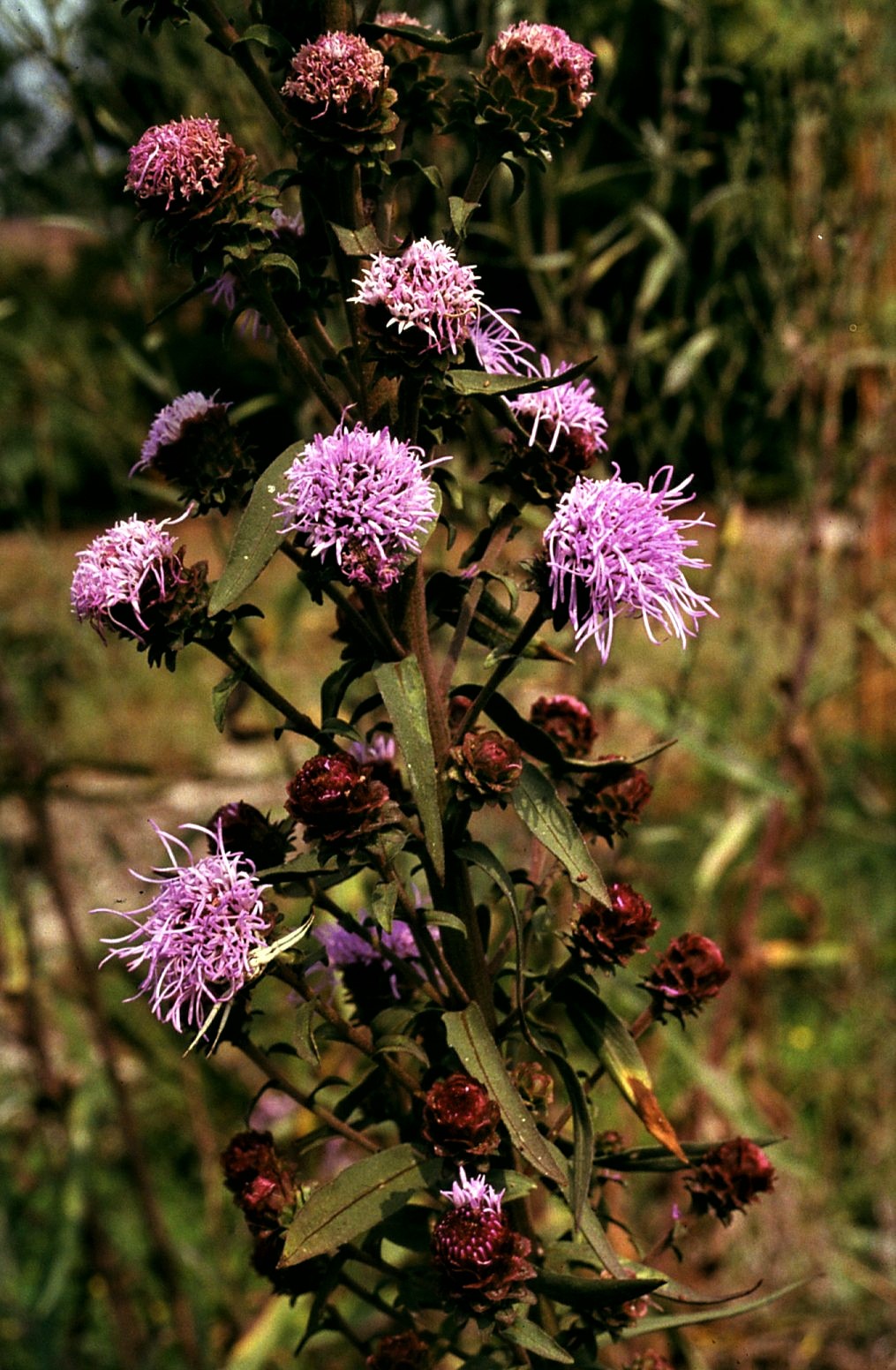
After some research it was determined to be Liatris ligulistylis, a
species considered quite rare. That later became L. scariosa nieuwlandii and
of course still just as rare. It is insightful to read the extensive species
treatment in the new 'Steyermark's Flora of Missouri'. It makes one realize the
complexity that goes into species concepts across their often wide range. Years later, as I reviewed Liatris aspera
herbarium sheets at the Illinois State Museum I came across numerous specimens
that had been mislabeled for they were clearly the former. Some of us have been
fortunate to see this always impressive plant several times on recent field
trips at the Horn Prairie Grove Nature Preserve in adjacent Fayette County. It
remains uncommon both in Missouri and Illinois as its savanna habitat continues
to shrink.
And that brings me now to the main
subject for these PP notes, a book just recently published by the SIU Press, by
John E. Schwegman; The Natural Heritage of Illinois. Essays
on its Lands, Water, Flora and Fauna. 2016.
 |
| Savanna Blazing-star [Liatris scariosa]. |
Most of
the essays were news releases from the early 1990's, a few of which I
vaguely remember from our local news papers; 2 of these pertained to the Shoal
Creek Conservation Area. I had known John long before that [See also above]. At
his urging we made a pitch to our city council for protection as a state natural area. Neither
the mayor nor the council were in favor at the time as there had been maps and
proposals for that lakeside area that involved major recreational and resort
developments. Full protection was offered in 1989, but under city control. I
think it involved 3 attempts. It had been a 'local control' issue all along. In
retrospect that has turned out to be a real blessing as results on the ground
go. Our volunteer organization, the Shoal Creek Volunteers, Inc. has had unstinting support as we
implemented burn management, invasives control and canopy reduction in
restoring barrens and flat-woods communities.
Speaking
again about connections, without John there would not have been a Shoal Creek
Conservation Area and most likely not the discovery of the new fungus species
mentioned above.
Back
to the book. It is not only by far the best publication on this subject that is
available here in Illinois. John had been the state's botanist until his
retirement and as such added greatly to the knowledge of our state's natural
communities. For 'just' being press
releases he communicated the wonders of our natural world in remarkably fine
prose and well crafted detail. Where else can one read about observing mussels
gone fishing or talking [communicating] with wolf spiders? Such a book deserves
wide distribution in our state, which is often considered a bit challenged on
the subject of nature appreciation and protection. It should be in every school
and public library. This year we are celebrating the 100 year anniversary of
our National Parks. What a great time to remind ourselves that even in this
land of corn and beans we have a lot of natural diversity and our lives can
still be enriched by wondrous new discoveries.
As an aside, I had borrowed the book, twice,
from our always very accommodating Carnegie Library. To my considerable
surprise a copy arrived in the mail. I eventually found out that it was a gift
from one of our board members. How gratifying. I believe this book is available
in Springfield book stores and of course from on-line purveyors. You will enjoy
it even without the local connection.
Last month's column also had a local
connection. I will retain the heading but shorten it. The full text can be
found on the website of the Illinois Native Plant Society.
Plant
Profiles; Monarda
bradburiana and Plant Preservation
 |
| Monarda bradburiana; May |
Our esteemed INPS editor, Alana,
recently forwarded a request, seeking seed for Monarda bradburiana. Eastern
Bee-balm is not exactly an evocative common name and we will therefore stick
with the botanical one. Of course, as we all know too well that does not always
work as smoothly as we might like either.
 |
| Monarda bradb; May bloom |
You will on occasion see it listed as
M. russelliana. Not too bad really as the 'names confusion' is often far more
extensive.
Jeff
Carstens, from the USDA-ARS Plant Introduction
Station at Ames, Iowa was looking for its seed for their seed germplasm banking
program. You can find out more at:
http://www.ars-grin.gov/npgs/index.html. It was an easy request to fill as even at the late date a
lot of seed remained on the plants. This Bee-balm is still abundant in the
barrens and open woodland communities at the Shoal Creek Conservation Area. Its
numbers
 |
| Monarda bradburiana fall color |
are currently in decline and will continue so over the years unless we
can get back on schedule with regular
prescribed burns. It is just one of a whole suite of southern till-plain
woodland flowers that responds spectacularly to a fire regime that they evolved
with over many millenia. A nice plant
will form a compact mound, less than 2' tall. The delicate pink flowers,
covered with purple dots are abundant in late spring. Under favorable
conditions the glossy foliage assumes pleasing fall colors. The species no
doubt occurs in every county in southern Illinois were the woods remain open
and free of invasive species.
Ken Schaal and I
participated in 2013 in a similar program by the Chicago Botanic Garden. It is
affiliated with the BLM's SOS [Seeds of Success] seed banking program and Kew
Garden's Millennium Seed Banking Programme. We collected well over 100 species.
In addition to a 2 page data sheet it also involved a series of photographs and
herbarium sheets. As I recall it was
quite a challenging project. You can
find out more at this website:
http://www.sciencecollections.org/content/dixon-national-tallgrass-prairie-seed-bank.We have used the stipends in managing the Route 66 Prairie
north of town.
Both Chicago
Botanic Garden and down our way Missouri Botanic Garden are involved with
another critical preservation program, the Center for Plant Conservation. In
addition to the ex situ programs above this one involves in situ work and
species restoration. The emphasis is on highly endangered species. For over 20
years we have been able to provide a home for the very rare Heart-leaf
Plantain from this program in one of our
valleys. Plantains tend to be major weeds, but certainly not this one. At over
2 feet across it would be a heck of a weed! Even at that impressive size it is
an unassuming plant, though not to deer and perhaps other herbivores. We
monitor it every year.
That brings us
full circle as in the end all preservation is local. This may have been
a bit of a boring presentation. Never mind as long as it encourages you the
dear reader, to do YOUR PART to preserve our natural heritage in your neck of
the woods.
Of course that
admonition in that last paragraph goes for all of us as well. Above all, we
urgently need to spread that message to a younger generation.
40 Oaks Project
 |
Blackjack oak in flat-woods ,
60-70 ft. exceptionally tall |
 |
| 40 Oaks project Blackjack Oak |
The University of
Illinois Plant Clinic is celebrating 40 years of service. Earlier this year
they
had sent out sent out invitations for proposals featuring some special oak
tree and recording observations about it during this calendar year. They also
suggested community participation. We submitted a Blackjack Oak at the Shoal
Creek Nature Preserve and were accepted. Two high school students, Garrett
Werner and Julia Brandtner assisted in the monthly observations. We look
forward to the final report and will share the results with our readers.
 |
| Henry and his group from the All class Reunion |
Litchfield High school All-Class Reunion
A small but
inquisitive group toured the nature trail and it was well reported by our
newspapers. One pair of sharp eyes spotted a mushroom that I had not seen
before. Turns out, Coral Mushroom, (Ramiria aurea) is not that
rare. It even occurs in Europe and listed in my German reference book as
edible. Nature is infinitely varied and fascinating. You can learn something
new all the time. Shown with Henry from left to right are Beth Christ, Terre Haute, IN; Edie Phillips, Cody, WY; Jane Hanafin, Memphis, TN; Candi Brown, Litchfield, IL; Sherry Boehme, New Bern, NC.
 SCCA Sign and Flower Bed
Several board
members worked on reducing the size of the sign planting and re-mulching it.
Its maintenance will need to continue and we are looking for some more
volunteers. Much of the lettering of the top board of the sign had flaked off
and was in need of repainting. It was taken down and Bill Borklund repainted
it. It really stands out now!
There is a new fungus among us!
 |
| Mushroom details show X. shoalensis |
I have copied the
item below from an e-mail that I received. Dr. Andrew N.
Miller is Mycologist and Director of the Herbarium at the
Illinois Natural History Survey, University of
Illinois. See his brief bio below. We bask in the glow of his considerable
fame. What little we still know of the
natural world around us. This is so much more exciting than the 'virtual
reality' of our technology that increasingly surrounds and envelops us.
New
Species to Science Discovered at Shoal Creek Conservation Area (Yes, it’s a fungus!)
A new
species to science discovered at the Shoal Creek Conservation Area (SCCA) was
recently published in the international journal of fungal systematics,
Sydowia. The fungus, Xylomelasma shoalensis A.N. Mill., Y.
Marín & Stchigel (Figure 1), was named after the place where it was
collected and is the only known record of this species.
Xylomelasma
is a genus of decomposers introduced in 2006 to accommodate two new taxa
isolated from rotten wood, X.
novae-zelandiae and X. sordida. Recently, another new species isolated from
the same type of substrate, X. moderata,
has been described. Xylomelasma shoalensis can easily be distinguished from the other
species in the genus by the shape and size of its spores.
Andrew
Miller started his mycological career by conducting a mushroom inventory of the
Shoal Creek Conservation Area in the summer of 1992. He served as Treasurer for the Shoal Creek
Volunteers during the organization’s first three years. After completing his Ph.D. at The Field
Museum in December 2003 on the systematics of very tiny black fungi on wood
(pyrenomycetes), he wanted his first official herbarium specimens to be special
so he headed to SCCA in April 2004 to collect whatever he could find (three
specimens with collection numbers ANM 1, ANM 2 and ANM 3). These were tentatively identified, preserved
and accessioned into the Illinois Natural History Survey herbarium where they
remained unexamined for 10 years until a visiting doctoral student from Spain
was given them to study. Yasmina Marín
examined ANM 1 and determined that it was a new species so it was described,
illustrated and submitted for publication.
The full citation for this publication is:
Ginseng Study
 |
| American Ginseng |
 |
| Pounding leaf DNA into the test strip |
A few months ago two people from the Illinois Department
of Natural Resources contacted us looking for information on possible wild
Ginseng growing in Montgomery county. We
knew of at least two locations where Ginseng had been seen. One was
located near the end of Westlake Trail and while Henry showed them the spots,
Bill Borklund took pictures. We found about a dozen small Ginseng plants, some
with red berries still on them. One of the researchers took leaves and ground
them to a pulp in a mortar and pestle. The ground up leaf was them transferred to
a sterile paper tab which
was indexed for later DNA testing. Someday we hope to
know the origin of Montgomery counties wild Ginseng.
SCCA Steward Report

We continue to
monitor, record and photograph as needed. We received additional herbicide from
the Nature Conservancy and the Volunteer Stewardship Network. It will come in
handy in the control of invasives. Honeysuckle and other woody invasive species
are showing up in large numbers. We may always have to deal with that. Fire
management would really help. We met

with our fire chief and as in the past can
count on the support of our fire department. A lot of planning is required,
beginning with firebreak work, smoke management and so much more. Foremost are
always safety concerns. So far, as in past years, the weather conditions have
not been conducive to burns. We will try and be proactive on short notice.
Please
volunteer to man the fire lines, as so many of you have done in the
past.

At the Route 66
Prairie we contracted for a spring burn and separately for the continued
control of Teasel. With the great growing season there was also spectacular
flowering. We are hopeful that we can some day have the necessary
infrastructure of parking, paths and signage to make it accessible to the
general public. We had one of our great supporters mow a loop through part of
it this summer, but it was still

difficult walking. I was asked to take part in
a survey of
'Singing Insects'. In a rather short period we came up with over 10
species of grasshoppers and katydids. There are also crickets out there and
even the rare Prairie Cicada; all of these being musical insects! We had quite
an abundance of a few butterfly species late in the season. I saw a fair amount
of Monarchs and took quite a few photos. On closer examination most of these
turned out to Viceroys, a Monarch mimic.
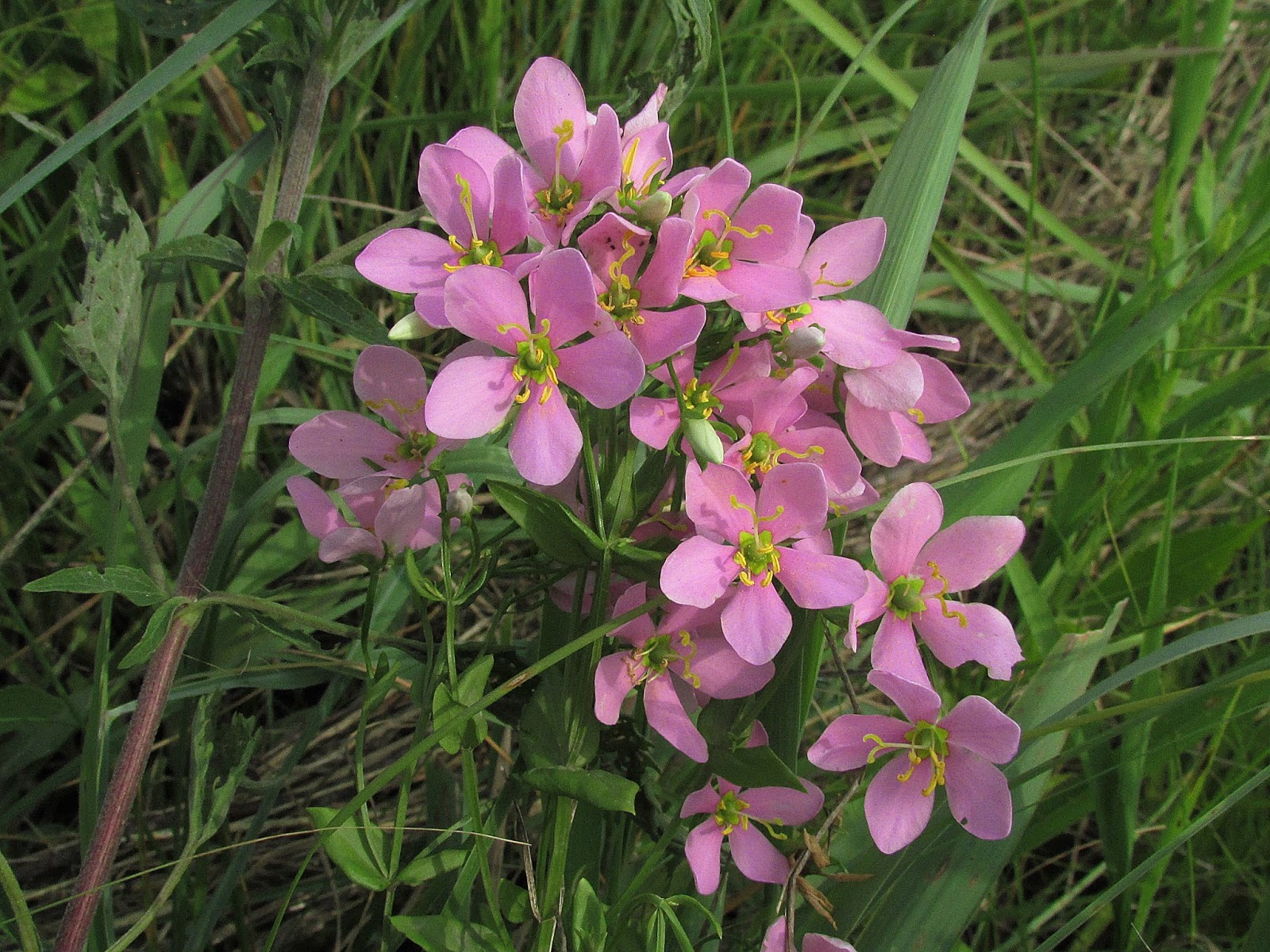
This tiny 10 acre patch may well be one of the best remaining examples of a Southern Illinois Till-plain prairie and as such needs to be put on the map, as they say. We have all sorts of ideas, but have to deal with funding and ownership issues. Your help or suggestions are truly appreciated.
The Board of Directors of Shoalcreekvolunteers wishes you a very happy new year. If you are a
Sustaining Member please remember that we need your money but not that much of it. Please make an annual contribution of $10 by sending your check to our trasurer, Jim Stapleton at 364 Westlake Trail, Litchfield, IL 62056.
All photos without attribution were taken at the Rt. 66 Prairie.